
A visa-free list without day limits is trivia. The day limit is the trip.
- Japan: 90 days visa-free for Americans. Plenty.
- UAE: 30 days on arrival for Americans, extendable twice.
- Thailand: 60 days visa-free for 93 nationalities.
- UK: 6 months for Americans.
- Schengen: 90 days in any 180-day window, now counted automatically by the Entry/Exit System.
That is why a simple list is the wrong shape for this information. The useful shape is a passport visa requirement matrix: one row per passport, one column per destination, and a day limit sitting inside every visa-free cell. A list tells you a country appears somewhere. A matrix tells you what happens with your passport, on your route, for the length of your trip.
What the matrix says about day limits
We pulled the current snapshot of this site's database to test the point: 195 passport-to-destination records, covering 13 passports and 57 destinations. Only 73 of those records are visa-free routes that state a stay limit, and the spread is wider than most list articles admit.
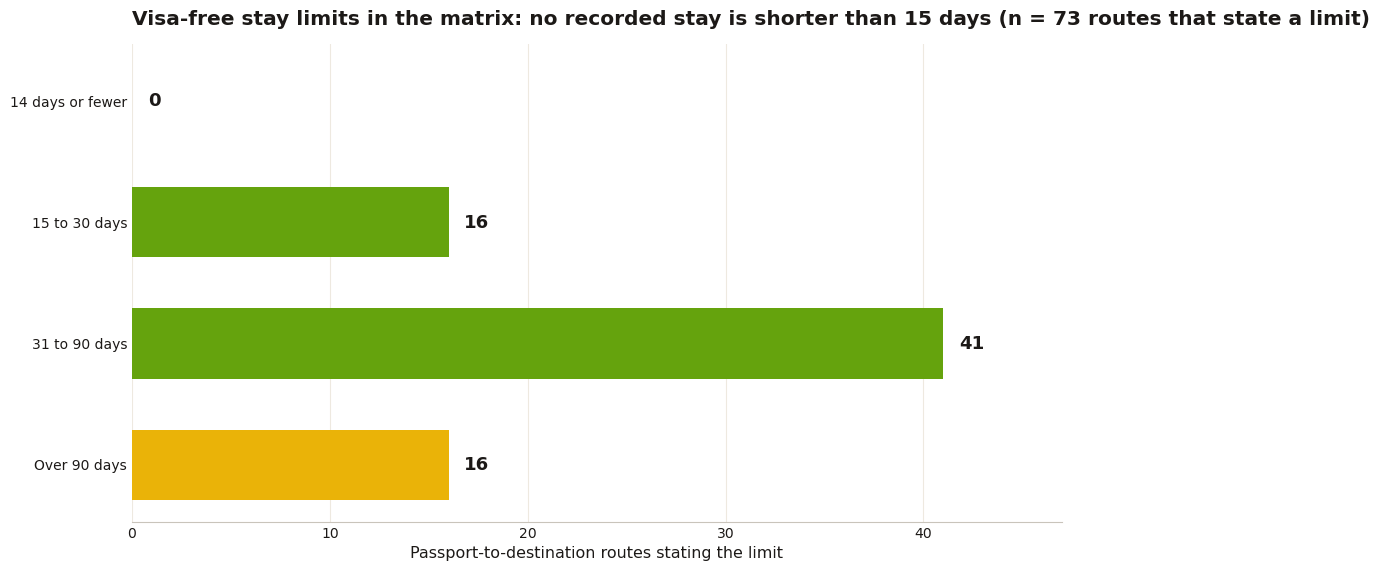
Source: eVisaPreparation database, 195 records, Oct 2026 snapshot. Chart counts the 73 records that state a visa-free stay limit. Rules change; confirm against official sources before you book.
Three findings matter for planning. First, no recorded visa-free stay is shorter than 15 days, so the horror story of a one-week stamp is rare in practice. Second, the middle band dominates: 41 of the 73 routes sit between 31 and 90 days, and 90 days alone accounts for 39 routes. Third, the long stays are real but specific: 16 routes run past 90 days, including 14 routes at 180 days. The limit is not a footnote to the route. In most cases it is the route.

The United States passport shows the spread inside a single row of the matrix. All 15 of its recorded destinations are visa free, yet the limits run from 30 days in the Dominican Republic to 240 days in the Bahamas, with Canada, Costa Rica, Mexico and the United Kingdom at 180 days and most of Europe at 90. Same passport, same green light, six different trips.
Two travelers can both be "visa free" for the same country and have completely different trips. The 30-day stamp and the 90-day stamp are not interchangeable, and overstaying either one now leaves a digital trail.
Read your row, not the list
Before you celebrate a visa-free destination, read the number next to it. Then plan the return flight inside that number, not at its edge. The matrix view makes this a thirty-second habit: find your passport's row, read across to your destination, and note the limit and any conditions attached to the cell.
That is the check PassportPower runs for this site: the day limit, fee, and conditions per passport in one check, $9.99 one-time per destination, so the list and the limits arrive together. If the trip includes a connection, run the layover through the Transit Visa Checker as well, because a visa-free destination does not guarantee a visa-free transit.
The destination side of the matrix makes the same point from the other direction. Thailand appears for nine of the recorded passports as a visa-free route, and every one of those rows states the same 30-day limit, while Egyptian, Pakistani and Bangladeshi passports are routed to an eVisa for the same country. Georgia gives a Russian passport 365 days, the longest stay in the database, and Turkey gives the same passport 60. A list article that says "Thailand: visa free" is describing one row of that table and silently skipping the rest.
Three habits make the matrix useful instead of decorative. Check the row for your passport, never the row for the passport you wish you had. Read the day limit as a return-by date and count it from entry, not from booking. And re-check the row before departure, because limits and conditions are the parts of the cell most likely to change between the day you book and the day you fly.
None of this requires new information. It requires the existing information in the right shape, rows and columns instead of a ranked list written for nobody in particular.
Sources: U.S. State Department, IATA Travel Centre