
Three apps, three jobs.
TripIt builds itineraries from confirmation emails: flights, hotels, and booking references in one timeline. It does not check visas. Its value is keeping the trip's facts straight when a consulate asks for your itinerary.
Google Translate is the form-reading tool. Camera mode translates foreign-language visa forms and signs in real time. Offline packs make it work without signal. It will not tell you whether you need a visa.
XE Currency does the money math. Visa-on-arrival fees, reciprocity fees, and extension costs all land in foreign currencies. Knowing the USD equivalent before you reach the counter avoids bad on-the-spot decisions.
What the stack is missing is the document that ties the three together: an offline visa checklist app layer that holds the rule for your route, the fine print attached to it, and the fee you will pay, all readable at a border desk with no signal. The data shows why that layer has to hold more than a yes or no.
The fine print is half the database
We harvested this site's requirement database for this article: 195 passport-to-destination records. The headline rule for each route fits in two words, visa free, eVisa, on arrival, required. But 101 of the 195 records, just over half, carry an additional reciprocity note: a condition, an exception, or a fee detail that changes what the headline means.
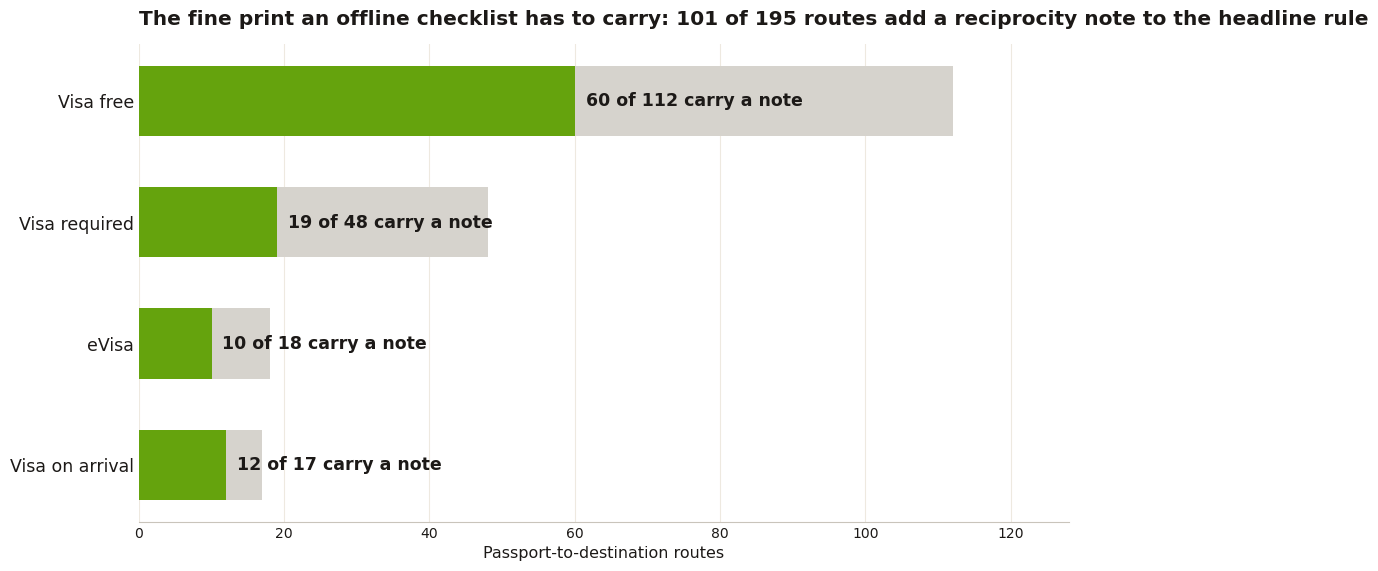

Source: eVisaPreparation database, 195 records, Oct 2026 snapshot. Chart counts records carrying a reciprocity note, out of all records in each requirement category. Rules change; confirm against official sources before you book.
The notes cluster exactly where travelers get caught. Twelve of the 17 visa-on-arrival routes carry one, and 15 routes state an arrival fee in dollars, running from $0 in the Maldives and Qatar to $31 for Indonesia and $56 on the Egypt to Jordan route. A checklist that stores only the headline would tell you "visa on arrival" and leave the fee, the cash requirement, and the exception at home, which is where they do you no good.
So judge an offline visa checklist app by what it caches. The rule, yes. The note attached to the rule, the fee in both currencies (that is XE's job, done before departure), the itinerary the rule depends on (TripIt's job), and the translated version of any form you will be handed (Translate's offline packs). Downloaded the night before, that bundle works in airplane mode, in a basement consulate, and at a land border with one bar of signal.
Build the stack before you fly
The stack works because each app does one thing. TripIt organizes, Translate decodes, XE prices. Add a proper visa checker for the actual requirements, and the four together cover the whole trip. Use this site's requirement search to pull your route's rule and note while you still have a connection, and if the itinerary connects, check the layover in the Transit Visa Checker, because transit rules are the notes most likely to be missing from a general checklist.
The notes are not legal trivia; they are the part of the record that changes behavior at the desk. One record in the database notes that Chinese consular visa fees are waived for Pakistani citizens under a reciprocal arrangement, which changes the budget line for that route to zero. Another records that GCC nationals do not require a visa for Bahrain, which changes the answer for a Saudi passport from the general rule to an exemption. A third, attached to several Maldives routes, states plainly that the 30-day visa on arrival is free. None of that fits in a two-word headline, and all of it is exactly what a traveler is asked about.
A practical offline bundle, built the night before departure, looks like this. Save the rule and the note for every route in the trip, including the returns. Save the arrival fee in dollars and in local currency for any on-arrival route. Save the day limit as a date, not a number, so the countdown is visible. And save the transit rule for every connection, because the layover country is the one nobody researched. If the checklist app you use cannot hold those four things per route without a connection, it is a bookmark, not a checklist.
Sources: U.S. State Department, IATA Travel Centre