
Bulk visa filings fail in predictable ways.
One typo in a shared detail, like a hotel address copied across six forms, becomes six rejections. Children need separate applications everywhere; there is no family bundle on India's e-visa portal. Different surnames within a family trigger extra questions. And when one member's passport expires sooner, the whole group's timeline compresses to the weakest document.
The fix is process, not speed. One master checklist, one document folder per person, one timeline anchored to the earliest expiry and the latest consulate slot. Apply as a batch but verify as individuals.
One trip, four different doors
The deeper problem is that a group rarely faces one rule. It faces one rule per passport. In this site's database of 195 passport-to-destination records, entry is offered four different ways: 112 routes (57 percent) are visa free, 48 (25 percent) require a visa before travel, 18 (9 percent) run on an eVisa, and 17 (9 percent) are visa on arrival. A bulk filing that assumes a single route for everyone is wrong for roughly half the rows before anyone types a name.
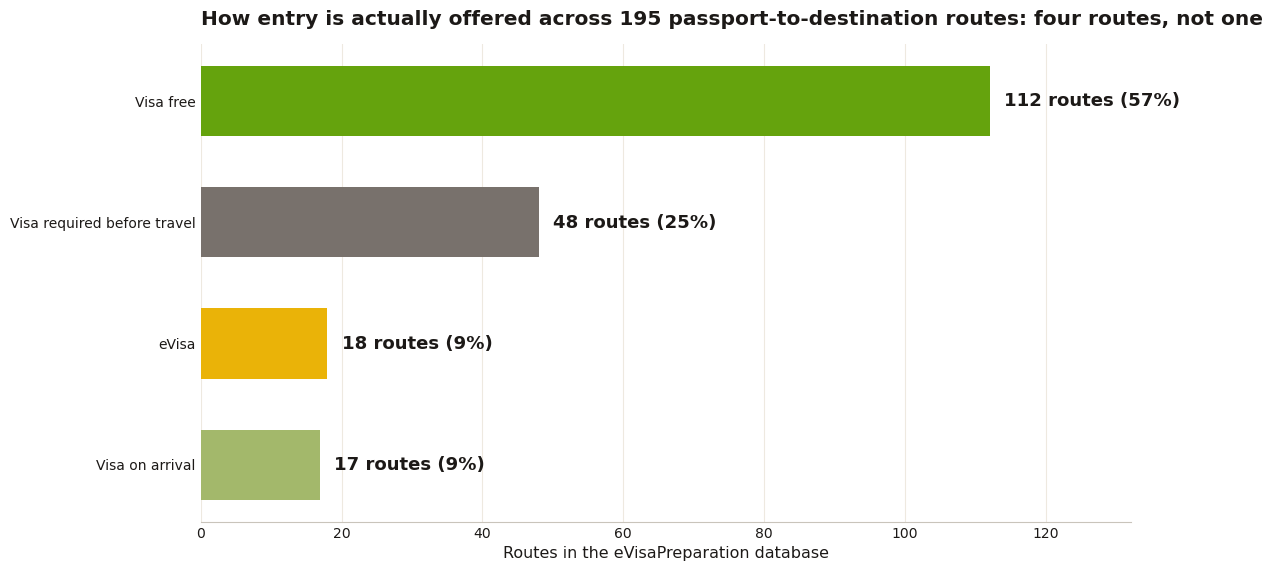
Source: eVisaPreparation database, 195 records, Oct 2026 snapshot. Chart counts every record by its stated requirement type. Rules change; confirm against official sources before you book.
Put two passports in one family and the doors split further. Across its 15 recorded destinations in the database, a United States passport is visa free on all 15 routes. A Pakistani passport is visa free on none of them: 9 routes need a visa in advance and 6 run on eVisas. An Egyptian passport needs a visa before travel on 11 of its 15 routes. The best visa application app for a group is the one that shows those rows side by side before anyone fills in a form, because the family's real deadline belongs to whichever member drew the slowest door.

This is the one case where a filing service consistently beats DIY. Coordinating six applications, six photos, six reference numbers, and one departure date is project management, and projects need a single owner.
What to demand from the app
Three features separate a group-ready tool from a solo checker. Per-passport answers in one view, so the four doors appear on a single screen. A shared timeline that works backwards from departure using the slowest route, not the fastest. And a document folder per traveler, because the weakest passport in the group sets the paperwork standard for everyone.
PassportPower was built for exactly this: family and group applications handled as one coordinated batch, $9.99 one-time per destination. For the flights themselves, run every connection through the Transit Visa Checker; a group that clears the destination check can still lose a traveler at the layover.
The four doors also run on four different clocks, which is what breaks group timelines. A visa-required route waits on consulate appointments and processing queues. An eVisa route waits on an online approval that usually arrives in days but cannot be started before the window opens. A visa-on-arrival route has no lead time at all, but moves the risk to the arrival desk, where the fee, the photo, and the return ticket have to be right. And a visa-free route still carries a day limit that can differ per passport: for Thailand, the database records 30 days for nine passports and an eVisa instead for the other three. A group spreadsheet with one deadline column is lying to someone.
The working pattern is to plan from the slowest door backwards. Start the visa-required applications first, file the eVisas inside their windows, prepare the on-arrival documents as a printed packet, and set the whole group's return date inside the shortest day limit anyone in the group was given. That ordering, one owner, and one folder per person will carry a family of six through rules that defeat most bulk filings.
Notice what the fix is not. It is not applying earlier, paying for speed, or appointing the most organized relative and hoping. It is matching the process to the four doors, so each traveler's application moves at the speed of its own rule instead of the speed of the group chat.
Sources: U.S. State Department, IATA Travel Centre