
- PassportPower: group checklists, per-person document tracking, $9.99 one-time per destination.
- Apple Notes: scan everyone's documents into one shared note.
- Files: per-person folders with offline access for airport day.
- 1Password: stores passport numbers and application references for the whole family.
- Google Translate: camera mode reads foreign-language forms on the spot.
Every app on that list manages documents or notes. None of them is the source of the answers. The answers live in a passport to country visa matrix database search: a table where each row pairs one passport with one destination and records what that traveler actually needs. A family trip uses several rows at once, and the trip only works if every row is right.
The shape of the matrix a family searches
This site's matrix currently holds 195 records: 13 passports, each recorded against 15 destinations, spread across 57 destination countries in total. That spread matters, because the destinations are not covered evenly.
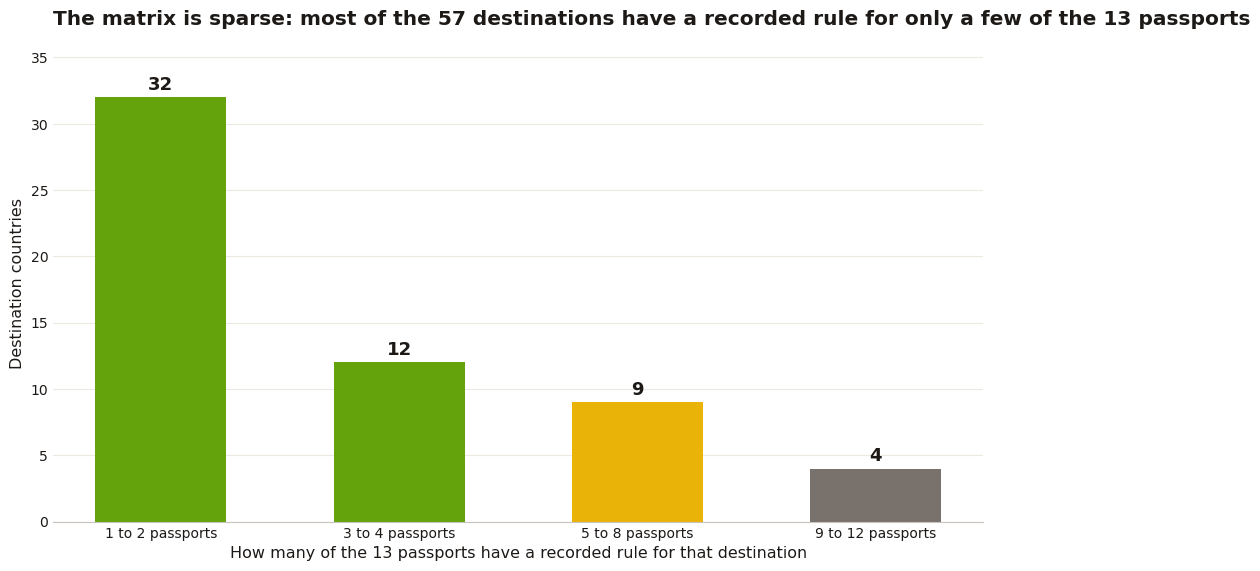
Source: eVisaPreparation database, 195 records, Oct 2026 snapshot. Chart groups the 57 distinct destinations by how many of the 13 recorded passports have a rule for each one. Rules change; confirm against official sources before you book.
Thailand is the deepest row in the matrix, with a recorded rule for 12 of the 13 passports; the United Kingdom and the United States follow at 11. But 32 of the 57 destinations have a recorded rule for only one or two passports. For a family, that is the practical warning: a database search that answers confidently for the parents' passports may have no row at all for a grandparent's or a spouse's, and "no row" has to be treated as a question to resolve, never as a green light.

Run the search the way the trip is built, one traveler at a time. Same destination, each passport in turn, and write down the four possible answers separately: visa free, eVisa, visa on arrival, or visa required. The family's plan is set by the strictest row, and the application calendar is set by the slowest one. Then check the connections for every traveler in the Transit Visa Checker, because transit rules are also per passport.
The family system that works: one shared note with a checklist per traveler, one folder per person, and a single calendar event for the application deadline with an alert two weeks out. The app matters less than the system. But the system needs an owner, and on iOS that owner is usually whoever's phone has the most storage free.
Coverage depth is uneven in the other direction too. After Thailand, the United Kingdom and the United States at 11 passports each, the next tier is Turkey with 9 recorded passports and the United Arab Emirates, Spain, France and Italy with 8 each. A family heading somewhere less covered should expect gaps and treat them as tasks: find the rule from an official source, save it with the trip documents, and note the date it was checked. The matrix is a starting grid, not a guarantee, and its gaps are information too.
The search results deserve a place inside the iOS system, not beside it. Screenshot each traveler's row into their document folder in Files, paste the day limit and the route type into the shared Apple Note under that traveler's checklist, and store the application reference, once issued, in 1Password next to the passport number. When the officer, the airline desk, or the hotel asks a question, the answer is then on the phone, per person, without a connection. Re-run the same searches a week before departure; rows change, and the family system only works if it is fresher than the last rule change.
One more habit separates the families who glide through check-in from the ones who argue with it: search for the return journey too. Entry rules are written per direction, and the passport that entered visa free may face a different row on the way home if the trip crosses a third country on the way back.
Coverage will keep growing, and the gaps will move. What does not change is the discipline: one row per traveler, checked close to departure, stored where the family can reach it offline.
Sources: U.S. State Department, IATA Travel Centre